
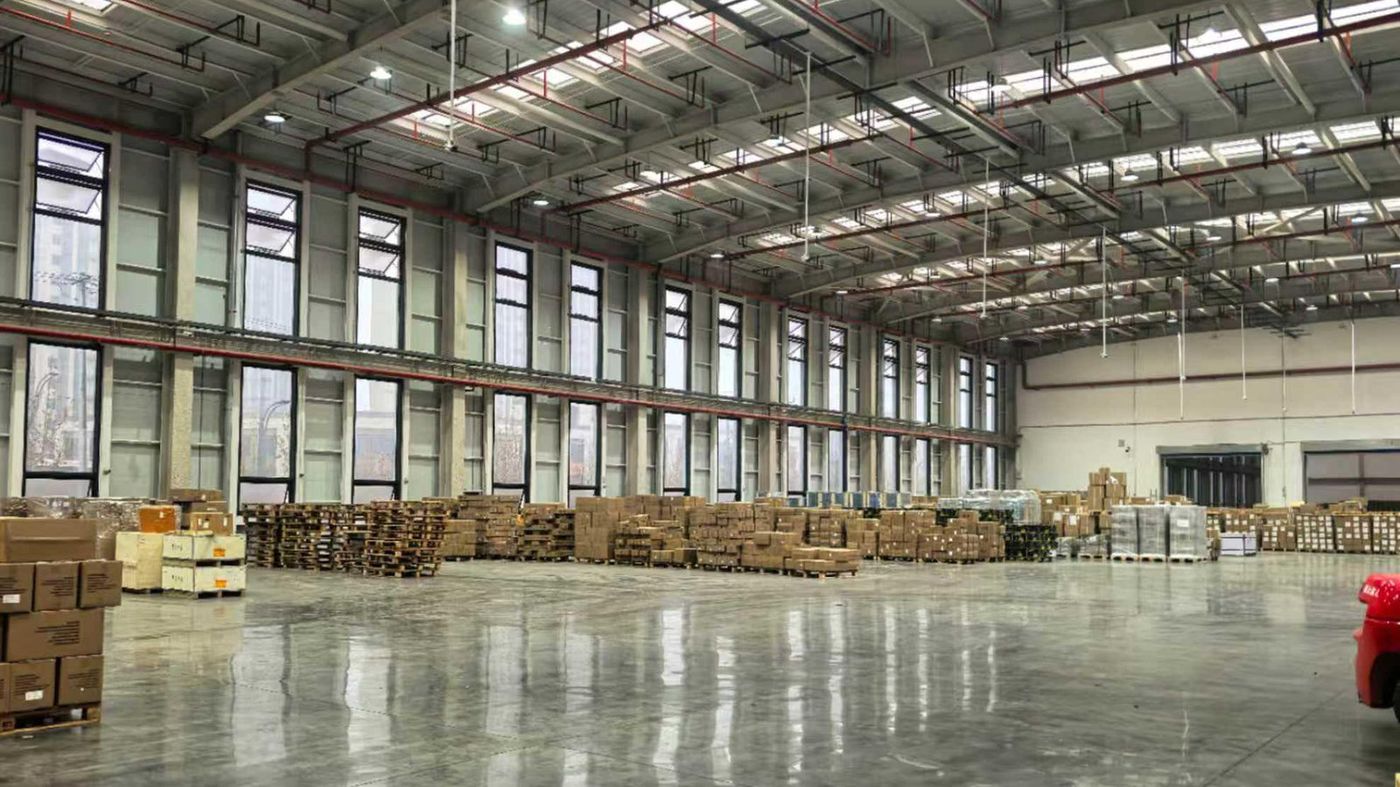
Where is the warehouse, and how far is it from the rail terminal?
Inside Xi'an International Port District, under 3 km from Xi'an International Port station: 6,000 m² of covered floor, eight loading docks and a temperature-controlled section. That distance is the commercially important number — cargo moves between warehouse, customs and the rail platform without a second truck leg, which removes both a cost line and a handling risk.
The same floor does two jobs that are usually split between suppliers: short and long-term storage, and the stuffing of groupage and FCL containers before the train cut-off.
Most cargo damage happens before the train moves
Importers tend to worry about the 10,000 km in between. In practice the damage is done in the last 200 metres: cartons crushed under heavier freight, a coil that was never chocked and rolled into the door, machinery that shifted because the base was never bolted down, paper goods that arrived damp because nobody lined the container. None of that is a railway problem. All of it is a stuffing problem.
That is the reason we run our own CFS instead of handing cargo to a yard we do not control. When the doors close, every action taken inside that box was taken by our team — so when something goes wrong we answer for it ourselves rather than forwarding the claim to a subcontractor.
Every stuffing job is photographed before and after securing, and the set travels with your documents. If a consignee disputes the condition of the cargo, those photographs are the first thing anyone asks for.
What we operate at Xi'an International Port
Our warehouse sits inside Xi'an International Port District — the same estate that originates the Chang'an block trains. The covered floor is 6,000 m² served by eight loading docks, and the rail station is under 3 km away, which is why cargo does not need a second truck leg between warehouse, customs and the rail platform. A temperature-controlled section holds cargo that cannot take a Shaanxi summer or winter. Under that roof we handle:
- Receiving and consolidation — cargo from several suppliers arriving on different dates, held and released as one shipment on one set of documents.
- Re-measurement — LCL cargo is re-measured and re-weighed on site, so the volume you are charged for is the volume that actually goes into the box.
- Stuffing and supervision — loading sequence and securing method set per commodity, with a supervisor on the floor.
- Securing and protection — timber frames, wedges, banding, stretch wrap, container liner and desiccant, combined to suit the cargo.
- Marking and labelling — shipping marks, barcodes and carton labels applied or replaced at the warehouse.
- Holding before cut-off — cargo staged until the next departure instead of sitting at a factory nobody can reach.
From receiving to release: what happens to your cargo
| Step | What happens | What you get back |
|---|---|---|
| 1. Receiving | Counted, weighed and photographed on arrival; checked against the packing list | Warehouse receipt with piece count, gross weight and measured volume |
| 2. Re-measurement | LCL volume and weight confirmed on our floor, not taken from the supplier's note | Confirmed chargeable volume, before the box is loaded |
| 3. Loading plan | Consignments grouped by destination station; heavy freight placed low and over the axles | Loading sequence agreed before stuffing starts |
| 4. Stuffing and securing | Loaded under supervision, secured by commodity-specific method, photographed before and after | Photo set of the loaded and secured container |
| 5. Release | Export declaration filed, container released to the rail platform | Declaration and release documents for your records and VAT rebate |
Securing by commodity
There is no universal bracing method. The four commodity groups below cover most of what moves through our floor, and each one fails in a different way if it is handled like the others.
| Commodity | How it fails | How we secure it |
|---|---|---|
| Steel coil and prepainted coil (PPGI) | Rolls and shifts; coated surface scratched by contact | Timber dunnage to spread the load, wedges plus high-tensile banding in a cross pattern, edge protection so no metal tooling touches the coating |
| Machinery and equipment | Centre of gravity shifts; painted or precision parts damaged | Base bolted to timber skids, blocking against forward movement, sensitive parts wrapped and braced separately |
| Cartons, paper and packaged goods | Absorbs moisture; collapses under stacking load | Palletised and stretch-wrapped, container liner plus desiccant, heavier pallets kept at floor level |
| Irregular or oversized pieces | Poor fill rate; moves in transit | Measured on the floor, then framed in timber to the internal dimensions of the container |
LCL is stuffed here — and only here
This is worth being precise about, because it changes what you can expect. Every LCL consignment we quote is stuffed in this warehouse. We do not sell "LCL from Hefei" or "LCL from Chengdu", because no groupage box exists in those cities. Three cubic metres collected in Hefei travels to Xi'an, joins other consignments bound for the same destination station, and leaves as one container.
That single fact is what lets us promise a fixed departure day and a one-CBM minimum. We are loading our own floor and matching cargo to the destination station — not waiting to see whether somebody else's box fills up. If your shipment is a full container, the opposite applies: FCL loads at the departure station, and there is no reason to truck it to Xi'an first.
Why three kilometres matters more than it sounds
A warehouse twenty or forty kilometres from the rail terminal still works — it just charges you in ways that never appear on the quotation. Containers have to leave a day early, so a consignment that arrives late misses the cut-off instead of being loaded. If customs calls for a physical inspection or a sample, half a day disappears into the round trip. And a carton found short at stuffing cannot be replaced the same afternoon.
At under 3 km, a container reaches the platform in one short drayage leg. Late cargo can still make the train, a measurement can be redone on the day of loading, and an inspection does not eat the schedule. That is the practical difference between a warehouse at the railhead and one that merely serves the same city.
The eight loading docks answer a different bottleneck. In the week before a departure, several suppliers' trucks arrive on the same morning and every one of them wants to be unloaded first. Eight doors means they unload in parallel rather than queueing at two, so a collection that would otherwise slip to the following train still makes this one — the same reason we re-measure on our own floor instead of trusting a supplier's note.
Storage, and what we will not claim
Cargo can be held at the warehouse while suppliers finish production or while a shipment waits for the next departure. With 6,000 m² of covered floor, hold space is rarely the constraint even in a peak week — what we quote per shipment is the storage term and the handling, because both depend on the commodity, the packaging and how long the cargo sits.
The temperature-controlled section is allocated on request rather than assumed: tell us the temperature range your goods need and how long they will be with us, and we confirm availability before you ship. We publish no temperature figure here because the right range belongs to your commodity, not to a marketing line.
Send the commodity, the piece count, the packaging type and the date the goods reach us, and you get a written handling plan covering storage, securing method and the documents we will produce.
Frequently asked questions
Where is your warehouse located, and can we visit it?
Inside Xi'an International Port District, Shaanxi — the hub of the Chang'an block train network and the origin of most of our rail departures. Visits can be arranged in advance, and we will walk you through the stuffing and securing process on the floor.
How big is the warehouse, and how far is it from the rail station?
6,000 m² of covered floor, self-owned, with eight loading docks and under 3 km from Xi'an International Port station — close enough that a container reaches the platform in one short drayage leg. A temperature-controlled section is available on request for goods that are sensitive to heat, cold or humidity.
Do you stuff and photograph LCL cargo yourselves?
Yes. Consolidation, stuffing, securing and weighing are carried out by our own team, and every job is photographed before and after securing with warehouse weight confirmation attached.
Who is liable if cargo is damaged during stuffing?
We are, when the damage comes from our handling. That is precisely why we stuff in our own warehouse and document every container — the responsibility boundary is clear instead of being passed between a forwarder and a yard.
Can you hold cargo before the train departs?
Yes. Cargo from several suppliers can arrive on different dates, be held at the warehouse and leave as one consolidated shipment. Storage and handling are quoted per shipment depending on commodity and duration.
Is my LCL shipment stuffed in my own city?
No. LCL consolidates at Xi'an only — cargo from other cities is collected and trucked here to be matched with consignments for the same destination station. Full containers, by contrast, load at your local departure station.
Can you handle returning or imported containers?
Yes. Containers arriving from Europe or Russia can be devanned at the warehouse, checked against the packing list and released to your consignee or forwarded domestically.